LOCATION:
We are located on the north end of Cheshire Bridge Road,
one block south of the I-85 overpass, between the
cross streets of Sheridan Road and
Chantilly Road.
While many things may affect the timekeeping rate of your clock,
none will affect it as much as changes in the ambient
temperature of its environment, assuming the mechanics of the
clock are in good working order. Excessive friction from any
source can have an adverse effect on the time keeping ability of
the movement. Every moving part must be good condition and
properly lubricated for the geartrain to operate as freely as
possible. Friction leads to wear which is your clock’s number
one enemy.
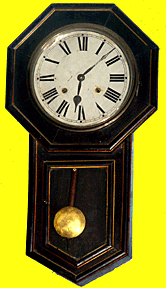
Regulation or the act of adjusting the rate of an pendulum clock
is a simple series of steps repeated until you achieve the
desired affect. You will accomplish this by changing the
location of the center of gravity along the length of the
pendulum.
Once you have observed a change in timekeeping over the course
of several days, it’s time to begin the regulation procedure.
Keep a pad and pen handy for recording notes, include the
starting error and all adjustments you make as this will greatly
assist the process. Remember to use a rate of error that’s
consistent, such as minutes or seconds per 24 hours, and to use
the same time source for making all of your comparisons.
Adjusting the pendulum shorter will cause your clock to run
faster while lengthening it causes it to run slower or simply
put "speedup, slowdown."
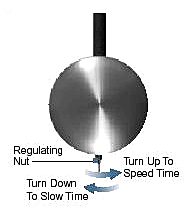
In the pendulum regulation diagram below, look for the rating
nut at the base of the pendulum which is what raised or lowers
the pendulum disk or bob. Remember that the pendulum disk may
become wedged against the rod, especially in the case of a
wooden stick and some help may be needed. Turning the rating nut
without affecting the disk has no bearing on timekeeping
By
turning the rating nut to the right the disk will raise, which
will make the clock faster while turning it left will lower the
disk and make the clock slower. The rule of thumb is one turn of
the regulating nut equals one minute per 24 hours, but your
results may prove different and that’s what makes the note
keeping
important to your success. Recording your actions for three or
four daily sessions is normally all that’s needed. You shouldn’t
try or expect to correct the error in one session, but rather
try to split the difference by half each session, slowly
sneaking up on the error without over shooting or see-sawing
back and forth.












 By
turning the rating nut to the right the disk will raise, which
will make the clock faster while turning it left will lower the
disk and make the clock slower. The rule of thumb is one turn of
the regulating nut equals one minute per 24 hours, but your
results may prove different and that’s what makes the note
keeping
By
turning the rating nut to the right the disk will raise, which
will make the clock faster while turning it left will lower the
disk and make the clock slower. The rule of thumb is one turn of
the regulating nut equals one minute per 24 hours, but your
results may prove different and that’s what makes the note
keeping